


Hiring the right team for a kitchen and bathroom renovation can be the difference between a smooth transformation and months of stress. These are two of the most technical spaces in any villa, apartment, or commercial property because they combine design, waterproofing, plumbing, electrical work, ventilation, cabinetry, tiling, lighting, and finishing in a relatively small footprint.
That is why choosing kitchen bathroom remodel contractors should never come down to the lowest quote alone. The best contractor is the one who understands your lifestyle, manages the technical details, communicates clearly, and can deliver a polished result that suits UAE homes and climate conditions.
This guide walks you through how to evaluate, compare, and confidently hire the right renovation contractor for your project.
Start With a Clear Renovation Brief
Before contacting contractors, define what you want to change. A vague request such as “renovate my kitchen and bathroom” can lead to unclear estimates, missing items, and costly variations later.
A useful renovation brief should include your goals, priorities, must-have features, preferred finishes, and any problems you want fixed. For example, your kitchen may need better storage, improved lighting, new countertops, upgraded appliances, or an open-plan layout. Your bathroom may need waterproofing repairs, better ventilation, a walk-in shower, new tiles, or a more luxurious hotel-style finish.
If you are renovating a villa in Dubai, also think about how the kitchen and bathrooms connect with the rest of the home. A luxury renovation should feel cohesive, not like individual rooms were upgraded separately.
Decide Whether You Need a Specialist or a Full-Service Contractor
Kitchen and bathroom projects often involve several trades. You may need civil work, plumbing, electrical upgrades, waterproofing, carpentry, countertop installation, tiling, painting, and interior design support.
A single-trade specialist may be suitable for a small upgrade, such as replacing bathroom fixtures or installing new kitchen cabinets. However, if you are changing layouts, moving plumbing points, upgrading electrical systems, or renovating multiple spaces together, a full-service renovation contractor is usually more practical.
| Project type | Contractor type to consider | Why it matters |
|---|---|---|
| Cosmetic kitchen refresh | Cabinetry, painting, or countertop specialist | Suitable when the layout stays the same |
| Full kitchen remodel | Full-service renovation contractor | Coordinates civil, MEP, carpentry, and finishes |
| Bathroom fixture replacement | Plumbing and bathroom fitting specialist | Works for minor upgrades with limited disruption |
| Full bathroom renovation | Waterproofing and renovation contractor | Reduces risk of leaks, drainage issues, and poor finishing |
| Villa-wide renovation | Luxury renovation company | Ensures design consistency and project coordination |
For UAE homes, coordination is especially important because apartment buildings, gated communities, and villa developments may have different access rules, work-hour restrictions, and approval requirements.
Check Relevant Experience, Not Just General Renovation Claims
A contractor may be experienced in general maintenance but not necessarily skilled in high-quality kitchen and bathroom remodeling. Ask for examples of similar completed projects, especially those matching your property type.
If you own a villa, look for evidence of villa renovation work, custom joinery, premium finishes, and larger-scale project management. If you are remodeling an apartment, ask about building management coordination, noise restrictions, material delivery planning, and working within limited service access.
Photos are helpful, but they are not enough. Ask what the scope included. Did the contractor only install cabinets, or did they manage plumbing, electrical work, waterproofing, countertops, and finishing? A beautiful photo does not always reveal whether the hidden technical work was done properly.
Verify Licenses, Insurance, and Approval Knowledge
In the UAE, renovation work may require permissions depending on the property, community, building, and scope. This is particularly important when work affects plumbing lines, electrical systems, structural elements, drainage, external areas, or shared building services.
A professional contractor should be able to explain what approvals may be needed and how they will help manage the process. For apartments, this may involve building management or owners’ association approvals. For villas, it may involve community or developer requirements. For larger civil changes, additional authority approvals may be necessary.
Ask for proof of valid business licensing and insurance where applicable. You should also confirm that the team follows safe working practices, especially for electrical work, demolition, cutting, waterproofing chemicals, and heavy material handling.
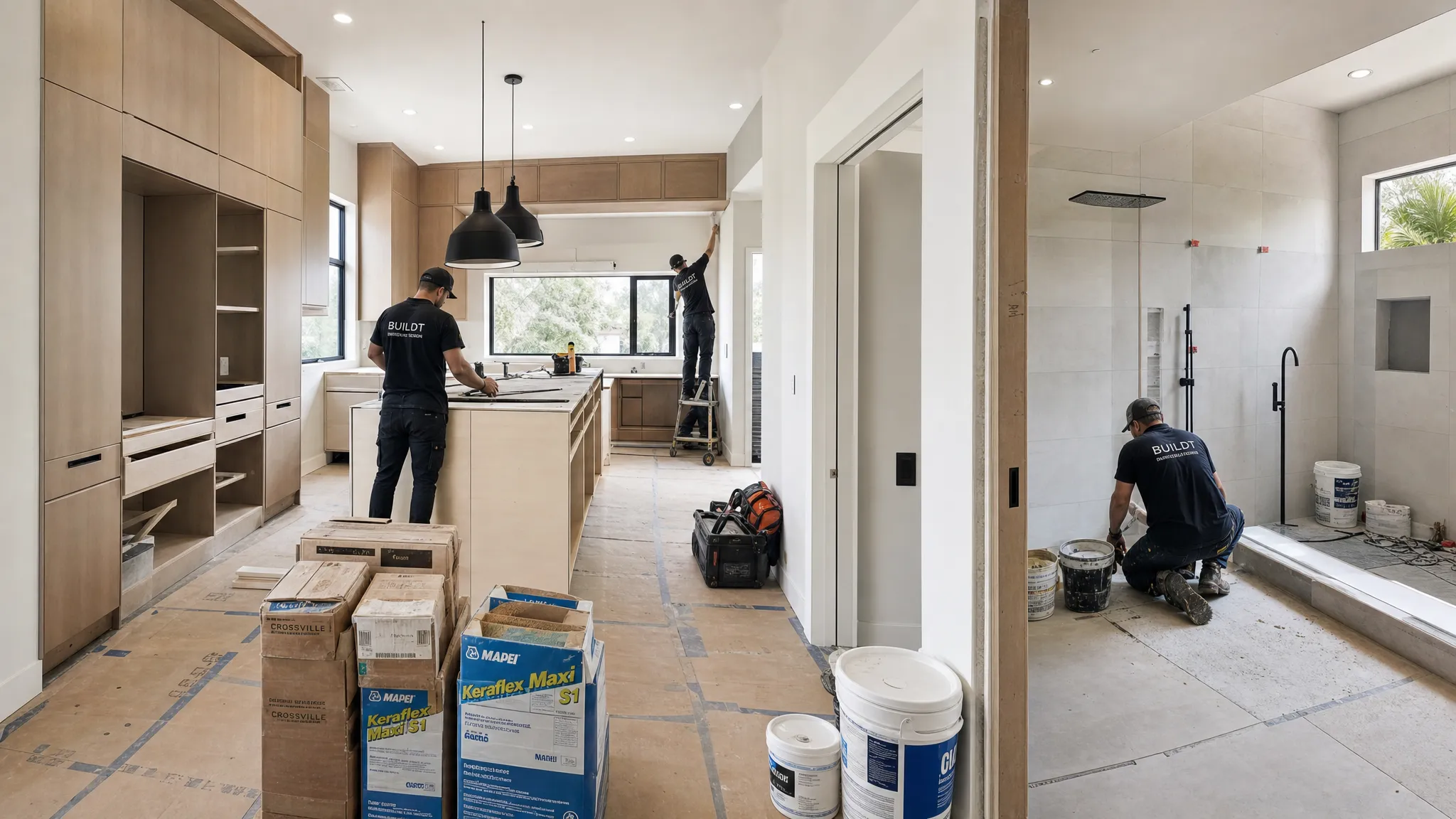
Compare Detailed Scope, Not Just the Final Price
The biggest mistake homeowners make is comparing quotes only by total cost. A lower quote may simply exclude essential items such as waterproofing, demolition disposal, tile adhesive, plumbing modifications, electrical upgrades, countertop installation, or finishing details.
Ask each contractor to provide an itemized scope. The proposal should make it clear what is included, what is excluded, which materials are specified, who supplies sanitaryware and appliances, and how variations will be priced.
A good quote for a kitchen and bathroom remodel should usually clarify:
- Demolition and disposal responsibilities
- Plumbing and drainage changes
- Electrical points, lighting, switches, and appliance connections
- Waterproofing method for wet areas
- Tile, grout, adhesive, and installation details
- Cabinetry material, hardware, and finish
- Countertop material and edge profile
- Painting, ceiling, ventilation, and finishing work
- Project timeline and payment milestones
If one contractor gives a one-page estimate and another provides a detailed breakdown, the detailed quote is often easier to trust, even if the initial price is higher.
Evaluate Design Support and Space Planning
Kitchen and bathroom remodels are not only construction projects. They are design and usability projects. A contractor should help you think through how the space will function every day.
In a kitchen, this includes cooking flow, storage zones, appliance placement, countertop workspace, lighting layers, ventilation, and movement between the kitchen, dining area, and living space. In a bathroom, it includes shower size, vanity storage, mirror lighting, drainage slope, towel placement, niche design, and ease of cleaning.
If your goal is a luxury finish, design support becomes even more important. Premium materials can still look disappointing if proportions, lighting, and installation details are not handled correctly.
For inspiration on making smaller bathrooms feel more open, you can also explore these bathroom renovation ideas before finalizing your brief.
Ask About Waterproofing and MEP Work
The most expensive renovation problems are often hidden behind tiles, cabinets, and walls. This is why plumbing, electrical, and waterproofing standards matter as much as visible finishes.
Bathrooms require proper waterproofing before tiling, particularly in shower areas and wet zones. Poor waterproofing can cause leaks, mold, damaged ceilings below, and repeated repair work. Kitchens also need careful plumbing for sinks, dishwashers, washing machines, and water filtration systems, depending on the layout.
Electrical planning should account for modern appliance loads, task lighting, under-cabinet lighting, extractor fans, shaver sockets, smart switches, and safety requirements. Avoid contractors who treat MEP work as an afterthought or cannot explain how the hidden systems will be tested before closing walls and floors.
Review Materials and Finish Quality
Material selection affects appearance, durability, maintenance, and long-term value. In the UAE, heat, humidity, dust, and heavy AC usage can influence material performance. Kitchens need moisture-resistant cabinetry, durable countertops, quality hinges, and easy-to-clean surfaces. Bathrooms need slip-conscious flooring, suitable grout, good ventilation, and fixtures that can handle frequent use.
Ask contractors to show actual samples where possible. Renderings and catalog images are useful, but physical samples help you judge texture, color, thickness, and finish. This is especially important for stone-look tiles, wood-effect cabinetry, countertops, and metal hardware.
Be cautious if a quote uses unclear terms like “standard tiles,” “good quality cabinets,” or “premium fittings” without brand, specification, or allowance. These phrases can mean different things to different contractors.
Understand the Project Timeline
Kitchen and bathroom renovations can disrupt daily life. A reliable contractor should provide a realistic timeline, not just an optimistic promise. The schedule should account for demolition, authority or building approvals if needed, material lead times, MEP rough-in, waterproofing, tiling, cabinetry fabrication, countertop measurement, installation, snagging, and final cleaning.
If you are living in the property during the renovation, ask how the contractor will reduce disruption. This may include dust protection, temporary water shutdown planning, work sequencing, site cleaning, and safe storage of tools and materials.
If the renovation is connected to a larger move, plan your dates carefully. Families relocating internationally often coordinate housing, schools, deliveries, and renovation timing at the same time, and services like Homeward Australia’s relocation support show how valuable early planning can be when many life logistics overlap.
Interview Contractors With Specific Questions
A professional contractor should welcome detailed questions. Their answers will reveal how organized, transparent, and technically capable they are.
Use your consultation to ask:
- Have you completed similar kitchen and bathroom projects in Dubai or the UAE?
- Who will supervise the site each day?
- How do you handle plumbing, electrical, and waterproofing work?
- What approvals or NOCs may be required for this property?
- Can you provide a detailed scope and material specifications?
- How are variations approved and priced?
- What is the estimated timeline, including material lead times?
- How do you protect existing floors, walls, lifts, and common areas?
- What happens during snagging and handover?
Pay attention not only to the answers, but also to the communication style. If a contractor is unclear before the project starts, communication is unlikely to improve once the site becomes busy.
Watch for Red Flags Before You Sign
A contractor does not need to be the cheapest to be the right choice. In fact, extremely low pricing can be a warning sign if it comes with vague scope, rushed promises, or pressure to start immediately.
Common red flags include refusing to provide a written scope, avoiding questions about licenses or approvals, asking for excessive upfront payment, offering unrealistic timelines, using unclear material descriptions, or dismissing waterproofing and MEP concerns. Another warning sign is poor responsiveness during the quotation stage. If replies are slow and disorganized before payment, the project experience may be worse after work begins.
Also be careful with verbal promises. Every important detail should be written into the agreement, including scope, exclusions, payment stages, timeline, materials, variation procedure, and handover expectations.
Review the Contract Carefully
A proper renovation agreement protects both you and the contractor. It should define what will be done, how much it will cost, when payments are due, and how changes will be managed.
For kitchen and bathroom remodels, the contract should include the project address, scope of work, drawings or layouts if available, material specifications, timeline, payment schedule, responsibilities for approvals, warranty or defect liability terms if offered, and cleanup expectations.
Do not rely on assumptions. If you expect soft-close hinges, concealed plumbing, a specific tile pattern, a particular countertop material, or a certain lighting layout, make sure it appears in the approved scope.
Plan for Snagging and Handover
Even high-quality renovation projects need a final inspection. Snagging is the process of identifying small issues before handover, such as uneven grout lines, silicone touch-ups, cabinet alignment, paint marks, drainage slope concerns, fixture adjustments, or missing accessories.
Walk through the finished kitchen and bathrooms carefully with the contractor. Test drawers, doors, lights, sockets, taps, showers, drainage, exhaust fans, and appliance connections. Check tile edges, corners, sealant, glass partitions, mirrors, and countertop joints.
A professional contractor will not treat snagging as a conflict. They will treat it as the final quality-control stage.
Why Hiring Locally Experienced Contractors Matters in the UAE
Renovation in the UAE has unique practical considerations. Contractors must manage building access, community rules, material availability, climate conditions, high-end finish expectations, and coordination between multiple trades.
Local experience helps avoid delays and misunderstandings. A contractor familiar with UAE villas, apartments, and commercial properties is more likely to understand how to plan deliveries, protect common areas, coordinate approvals, and recommend materials suited to local conditions.
For luxury homes, local experience also helps with finish standards. Details such as tile alignment, lighting warmth, joinery finish, countertop installation, bathroom drainage, and paint quality can significantly affect the final look.
Frequently Asked Questions
How do I choose the best kitchen and bathroom remodel contractor? Start by checking relevant experience, licensing, project photos, detailed quotes, material specifications, and communication quality. Choose a contractor who can manage design, civil work, plumbing, electrical, waterproofing, and finishing with a clear written scope.
Should I hire separate contractors for the kitchen and bathroom? For minor upgrades, separate specialists may work. For full remodeling, one full-service renovation contractor is usually easier to manage because the schedule, MEP work, materials, and finishing can be coordinated under one team.
How long does a kitchen and bathroom remodel take? Timelines vary based on scope, approvals, material availability, and whether layouts are changing. A simple refresh may take less time, while full villa kitchen and bathroom renovations can take significantly longer due to demolition, MEP work, waterproofing, tiling, cabinetry, and snagging.
What should be included in a remodeling quote? A remodeling quote should include demolition, disposal, plumbing, electrical work, waterproofing, tiling, cabinetry, countertops, fixtures, painting, finishing, timeline, exclusions, payment stages, and variation terms.
Is waterproofing really necessary for bathroom renovation? Yes. Waterproofing is one of the most important parts of a bathroom remodel. Proper waterproofing helps prevent leaks, moisture damage, mold, and expensive repairs after the tiles and fixtures are installed.
Ready to Remodel Your Kitchen or Bathroom?
Hiring the right contractor is about more than finding someone who can install tiles and cabinets. You need a team that understands design, technical execution, local requirements, and the level of finish your property deserves.
Renovate UAE provides customized renovation solutions for villas, homes, apartments, offices, and commercial spaces across the UAE, including kitchen upgrades, bathroom remodeling, interior design, civil work, electrical and plumbing services, carpentry, painting, and landscaping.
If you are planning a kitchen or bathroom renovation in Dubai or anywhere in the UAE, contact Renovate UAE to arrange a free site visit and estimate.